
Understanding the Evolution of Machine Learning
The journey of machine learning has been nothing short of revolutionary, transforming industries and redefining the parameters of technology. What began as simple algorithms has evolved into sophisticated systems capable of augmented intelligence, mimicking human thought processes and decision-making abilities. With the ability to analyze vast amounts of data promptly, machine learning is now an essential tool across various fields, shaping the future of business, healthcare, and even everyday activities.
Throughout its history, machine learning has traversed several key phases that have marked significant advancements in the field:
- Early Algorithms: The journey began with fundamental techniques like linear regression and decision trees. These methods laid the cornerstone for predictive modeling and were primarily used for simple problems such as sales forecasting and basic classification tasks. Early adopters saw the potential of these models in data analytics, gradually leading to more complex applications.
- Neural Networks: The emergence of multi-layered networks in the late 20th century was pivotal. By simulating human brain operations and interconnections, researchers were able to develop models that could recognize patterns in data far more effectively. This phase sparked innovations in areas like image and speech recognition, where traditional algorithms struggled.
- Deep Learning: With the rise of big data and advancements in computational power, deep learning flourished in the last decade. Leveraging large datasets, these models enabled breakthroughs in facial recognition and natural language processing. Companies like Google and Facebook harnessed deep learning technologies to improve user experiences and target advertising more effectively.
- Augmented Intelligence: The latest phase integrates AI with human intelligence for collaborative decision-making. This shift emphasizes the partnership between humans and machines, rather than replacement. In sectors like finance, for example, AI assists analysts in identifying trends quicker, ultimately driving better investment strategies.
This evolution has facilitated remarkable advancements across various sectors, including:
- Healthcare: Machine learning algorithms are now routinely employed for diagnosing diseases, such as identifying tumors in radiology images. Hospitals are beginning to integrate these systems to provide quicker diagnoses, improving patient outcomes while reducing costs.
- Finance: The finance industry utilizes machine learning algorithms to detect fraud in real-time, assessing spending patterns to flag suspicious transactions. This not only safeguards consumer assets but also builds trust in financial institutions.
- Transportation: Autonomous vehicles utilize machine learning to navigate complex environments. Companies like Tesla and Waymo harness enormous amounts of data from their vehicles to improve safety and efficiency in transportation.
As we dive deeper into this topic, you will discover how these technological advancements not only enhance efficiency but also raise pressing questions regarding ethics and the future of work. Issues like bias in algorithms and the potential displacement of jobs due to automation are hotly debated. The interplay between humans and machines continues to evolve, pushing the boundaries of what we once thought was possible, compelling societies to adapt and rethink their approaches as they embrace this technological revolution.
DISCOVER MORE: Click here to learn about the future of urban mobility
From Foundations to Innovations
The evolution of machine learning is a tapestry woven from the threads of innovation, exploration, and the pursuit of efficiency. In its infancy, the field was primarily concerned with creating mathematical models that could process data, a challenge met with simplistic yet effective algorithms. As technology progressed, so too did the methodologies, laying the groundwork for what we now recognize as advanced augmented intelligence.
In the early days, machine learning was marked by a limited understanding of how to harness data effectively. Researchers relied on algorithms such as linear regression, which could identify relationships between variables but fell short in more complex scenarios. The impact of these early models was nonetheless significant, paving the way for applications in fields like economics and marketing, where basic predictions were often invaluable. It was during this time that various stakeholders started to appreciate the potential of data-driven decision-making, birthing a new era in analytics.
The real transformation began in the 1980s and 1990s with the introduction of neural networks. By mimicking the neurons in the human brain, these models introduced a layer of intricacy previously unseen. Instead of merely executing calculations, neural networks could learn from past inputs, identifying patterns without extensive human intervention. This marked a paradigm shift, especially in applications like image and speech recognition, where traditional algorithms floundered. For instance, speech-to-text technology, once relegated to science fiction, began to materialize, impacting industries ranging from entertainment to telecommunications.
Deep Learning: The Next Frontier
The dawn of the 21st century heralded the age of deep learning. With access to vast amounts of data and significantly increased computational power, neural networks evolved into deep neural networks, characterized by multiple layers that enhance their capacity to analyze complex datasets. Companies, particularly in the United States, harnessed these advancements to create groundbreaking innovations; for example, Google’s deep learning algorithms have drastically improved their search engine results, making information retrieval more intuitive than ever.
Key developments in deep learning facilitated advancements in numerous sectors, enabling technologies that were once only theoretical. These include:
- Facial Recognition: Once a sci-fi trope, this application now encapsulates our interactions with smartphones and security systems, refining privacy and accessibility.
- Natural Language Processing (NLP): Companies like Amazon and Microsoft have leveraged NLP to enhance user interactions, creating virtual assistants that assist with tasks ranging from shopping to scheduling.
- Recommendation Systems: Platforms like Netflix and Spotify utilize deep learning algorithms to personalize user experiences, recommending content based on individual preferences and viewing history.
As we delve deeper into the implications of these technologies, it becomes clear that machine learning is no longer just a series of algorithms processing data. It is now an intricate dance between human ingenuity and machine capability, redefining productivity and decision-making. This transformational journey challenges us to embrace the opportunities and responsibilities that come hand-in-hand with this technological advance.
| Category | Advantages |
|---|---|
| Data-Driven Decisions | Machine learning optimizes processes by analyzing vast amounts of data, leading to improved accuracy and efficiency in decision-making. |
| Automation of Complex Tasks | With augmented intelligence, machines can handle highly complex tasks, allowing humans to focus on creative problem-solving and innovation. |
The transition from basic algorithms to augmented intelligence marks a pivotal point in the machine learning landscape. Early models, while groundbreaking, relied heavily on human intervention and rudimentary rule-based systems. As advancements in computational power and data availability flourished, more sophisticated techniques emerged, paving the way for today’s innovations. One of the most remarkable developments has been the integration of deep learning with neural networks, which mimic the human brain’s structure, allowing machines to learn from unstructured data. This capability not only enhances pattern recognition but also fuels sectors like healthcare, where predictive analytics can foresee patient outcomes with astonishing precision.Furthermore, the rise of reinforcement learning showcases how machines learn through trial and error, refining strategies through feedback loops. This has opened new horizons in areas like robotics and autonomous driving, where adaptability and real-time learning are crucial.As these technologies evolve, the humanitarian aspect also gains attention, emphasizing the need for ethical frameworks to guide development while ensuring that augmented intelligence serves society’s best interests. The synergy between machine and human intelligence is not just a technological leap; it’s a collaborative journey toward unparalleled innovation.
DIVE DEEPER: Click here to uncover the impacts of natural language on sentiment analysis
The Rise of Augmented Intelligence
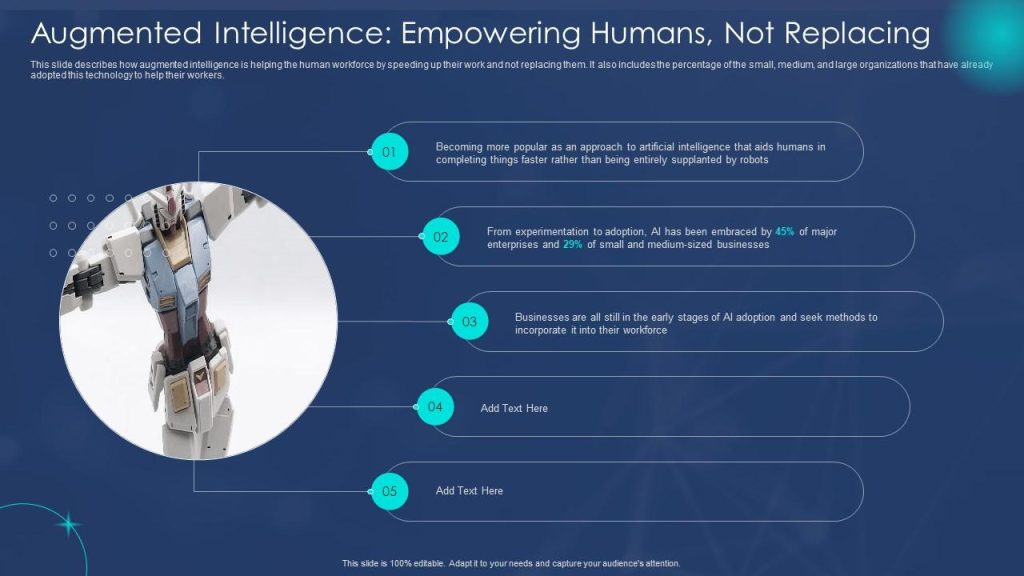
As machine learning matured, the focus began to shift from mere automation to a more sophisticated concept known as augmented intelligence. This evolution signifies a crucial change in how we view the synergy between humans and machines. Unlike traditional AI, which aimed to replicate human intelligence, augmented intelligence emphasizes the enhancement of human decision-making capabilities, paving the way for smarter solutions that integrate human insight with machine learning processes.
The term “augmented intelligence” encapsulates various advancements in machine learning techniques that help humans make better-informed decisions. One notable example is in the healthcare sector, where predictive analytics powered by machine learning can analyze patient data and predict potential health risks. Hospitals now utilize algorithms that evaluate a patient’s medical history to forecast conditions such as diabetes or heart disease, which aids physicians in designating preventative measures. IBM Watson has led the charge in this domain, analyzing vast datasets to provide recommendations for personalized treatment plans that clinicians can consider, thereby not just replacing human input but enhancing it.
Real-Time Decision Making
Machine learning is also reshaping the world of real-time decision-making. In finance, for instance, algorithms developed for fraud detection are capable of monitoring transactions as they occur. By employing models that learn from past fraud cases, these systems can flag suspicious activity instantly, allowing banks to respond to threats proactively. The prevalence of these technologies has underscored the importance of real-time data processing, leading financial institutions to invest heavily in machine learning frameworks that enhance security and customer trust.
Moreover, the impact of augmented intelligence is extending into the realm of autonomous vehicles. Companies like Tesla and Waymo harness advanced machine learning techniques to enhance navigation systems and traffic analysis. Their systems analyze multiple data points continuously, allowing vehicles to make safe, informed decisions in fast-paced environments. However, this innovation presents challenges as well; the need for precise algorithms raises questions about accountability and safety when machines must make life-and-death decisions.
Creative Industries and Machine Learning
Interestingly, the implications of machine learning also stretch into creative domains. Musicians and artists leverage tools built on machine learning to explore new forms of expression. Programs like OpenAI’s MuseNet and Jukedeck apply deep learning techniques to create music compositions that can inspire human creators or serve as foundations for further artistic innovation. These technologies serve not to replace creatives but to push the boundaries of artistic endeavors, illustrating that the partnership between humans and machines can cultivate remarkable achievements across various fields.
Furthermore, machine learning is transforming customer engagement strategies in businesses. Chatbots powered by natural language processing (NLP) are now ubiquitous in e-commerce and customer service, capable of learning from customer interactions to provide personalized recommendations and support. Companies like Zendesk and Drift have harnessed these capabilities for streamlined customer experiences, allowing representatives to focus on complex inquiries while chatbots handle routine queries efficiently.
- Healthcare: Personalized treatment recommendations.
- Finance: Real-time fraud detection systems.
- Autonomous Vehicles: Safe navigation and traffic analysis.
- Creative Arts: New music generation and collaboration tools.
- Customer Engagement: Efficient chatbot interactions.
The integration of machine learning into various sectors not only highlights its versatility but also its potential to augment human capabilities dramatically. As we progress further into the era of augmented intelligence, we face profound opportunities and challenges in harnessing these technologies responsibly for a future where human intellect and machine learning converge harmoniously.
DIVE DEEPER: Click here to learn more
Conclusion: The Future of Augmented Intelligence
As we stand at the crossroads of technology and human potential, the journey of machine learning from rudimentary algorithms to the sophisticated realm of augmented intelligence reveals a captivating narrative of growth and transformation. The evolution from simple rule-based systems to complex models that enhance human decision-making capabilities showcases not just technical advancements but a profound shift in how we perceive our relationship with machines.
Augmented intelligence embodies a partnership where technology complements human strengths, particularly in areas such as healthcare accuracy, financial security, and creative exploration. By leveraging predictive analytics, real-time decision-making, and innovative tools in creative industries, we are not merely automating processes but empowering individuals to achieve greater creativity and proactive problem-solving. This collaborative synergy expands the possibilities, allowing humans to transcend traditional limits and engage in more strategic roles across various sectors.
However, as we invest in these advanced capabilities, we must also address the ethical implications that arise. Questions about accountability in decision-making, the impact of bias within algorithms, and the need for responsible AI governance are essential for ensuring that the remarkable potential of augmented intelligence benefits society as a whole. As we navigate this new landscape, we should remain vigilant and informed, exploring the challenges alongside the groundbreaking advancements. Ultimately, the future of machine learning holds immense potential, and it is our responsibility to shape it into a force for good, fostering a world where technology and humanity move forward in concert.